
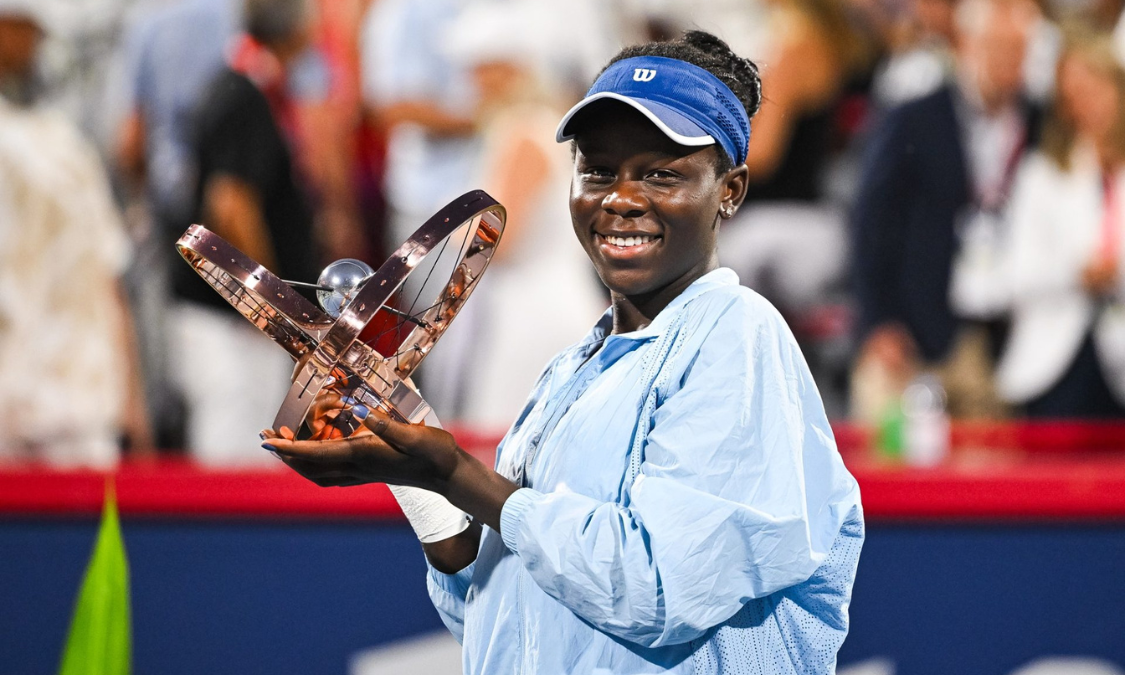
The world of sports is more than just games. It’s a powerful stage where identities are forged, stories are told, and new narratives are written. African women have often found this stage difficult to navigate, due to the stereotypes and systemic barriers they face. But every so often, a talent emerges that smashes the old script and forces the world to take notice. Right now, that talent is Victoria Mboko.
At Obaasema, we believe in the power of the African woman to shape her own destiny and inspire generations. That’s why we’re taking a deep dive into the phenomenon of Victoria Mboko not just as a tennis star, but as a beacon of African representation and a symbol of what’s possible when talent meets unwavering belief.
The Rise of a Champion: Victoria Mboko’s Journey
To understand Mboko’s impact, you have to know her story. It’s a journey that began not in a tennis powerhouse, but in a family that fled political turmoil in the Democratic Republic of the Congo. Her parents, Cyprien and Godee, moved to North America, bringing with them a commitment to a better future for their children. It was in this new landscape that tennis became a family affair, a shared passion that Victoria, the youngest of four siblings, embraced with incredible enthusiasm from a young age.
Her talent was undeniable and her path was anything but straight. She faced the typical challenges of a young athlete, including injuries, but her determination never wavered. Her breakthrough came with an astonishing start to 2025, where she went on a 22-match winning streak without dropping a set, claiming five ITF singles titles. This incredible run propelled her into the WTA top 200 and earned her a wildcard entry into her first WTA 1000 main draw.
But it was her performance at the Canadian Open that cemented her as a global star. Mboko stunned the tennis world, defeating four former Grand Slam champions, a feat that critics have compared to a young Serena Williams. She went on to win the title, becoming just the third Canadian to do so. In an instant, Victoria Mboko became more than just a name; she became a force.
Challenging the Narrative: Beyond the Stereotype
Mboko’s success is a powerful counter-narrative to the stereotypes that have long plagued African athletes. For decades, the global media’s portrayal of African women in sport has often been narrow, focusing primarily on distance runners from East Africa. While the achievements of legends like Tirunesh Dibaba and Faith Kipyegon are monumental, they don’t represent the full spectrum of African athletic talent.
Mboko, excelling in a sport like tennis that has historically been dominated by a different demographic, shatters that mold. Her visibility on a global stage is an act of representation that matters. It shows the world that African talent isn’t confined to a single discipline. It’s proof that with the right support, African women can thrive in any sport. This is why discussions around Top African women in sports must now include a wider range of disciplines and talents.
For young African girls, seeing Victoria Mboko on the world stage is more than just a highlight reel. It’s proof of what’s possible. It’s an invitation to dream bigger than they ever thought. It says, “The court is yours, too.” This kind of representation is crucial, because as Mboko herself said before her Montreal victory, “I’m truly a believer of you can do anything you aspire to do. The sky’s always the limit. That’s just how I like to go about things.”
The Systemic Shift: Moving the Goalposts
Individual success stories like Mboko’s are inspiring. But we can’t ignore the systemic issues at play. African female athletes, even the most gifted, face a trifecta of challenges. These include limited access to infrastructure, a lack of institutional support, and persistent cultural stereotypes. We’ve seen this in recent incidents. Some national teams have persistent struggles with funding and support. This happens even after major victories.
However, we are seeing signs of a shift. The conversation is changing, and institutions are starting to make moves. The Association of National Olympic Committees of Africa (ANOCA) for example has stepped up its commitment to promoting gender equality, investing in training programs for female athletes and coaches, and increasing funding for women’s sports. The establishment of events like the African School Games is also creating more opportunities for young talent.
This year, we are also seeing more private sector investment. For instance, the Totalsports Women’s Race announced a R1,000,000 incentive for the first female athlete to break the Women’s Only 10km World Record, a bold move that not only supports elite athletes but also sends a clear message about the value of women’s sports. These initiatives are vital because they create the infrastructure and financial backing that allows talent to flourish. They’re helping to build a pipeline of future champions, ensuring that the next group of Top African women in sports are not outliers but the new normal.
A New Generation of Trailblazers
Mboko is not alone in this mission. She is part of a growing group of African female athletes pushing boundaries across various disciplines. Just recently, the Super Falcons of Nigeria clinched their 10th WAFCON title, thrilling fans with a dramatic 3–2 victory over Morocco and proving their dominance in African football. On the basketball court, Nigeria’s D’Tigress secured another AfroBasket title, a historic fifth straight win that proves African women are a force across multiple arenas. And in Zambia, Barbra Banda continues to dominate African football, earning accolades and inspiring a whole generation of girls to lace up their boots. These women, alongside Victoria Mboko, are rewriting the history of African sport, one powerful performance at a time.
Victoria Mboko is rewriting the rules and showing the world that African talent isn’t confined to stereotypes. Alongside a new wave of trailblazers, she is proving that the future of global sport is African. It is female. And it is here to be celebrated.
